
A strong LinkedIn personal brand helps the right people find you, remember you and trust you before the first meeting. That applies to founders, managers, consultants and specialists alike. Yet many profiles stay invisible because they post without a plan or never post at all.
This guide shows how to build a LinkedIn personal brand in seven practical steps. It also explains what has changed on the platform recently and how to measure progress.
Why a LinkedIn personal brand matters in 2026
LinkedIn is the largest professional network in the world. According to its April 2026 business update, it now has more than 1.3 billion members. At the same time, engagement with expert content keeps growing. In its July 2026 update, LinkedIn reported 24% more knowledge-oriented posts and 18% more time spent reading comments than a year earlier.
For you, this means two things. First, your audience is on the platform. Second, people are actively looking for useful, expert content. A clear LinkedIn personal brand puts you in front of them.
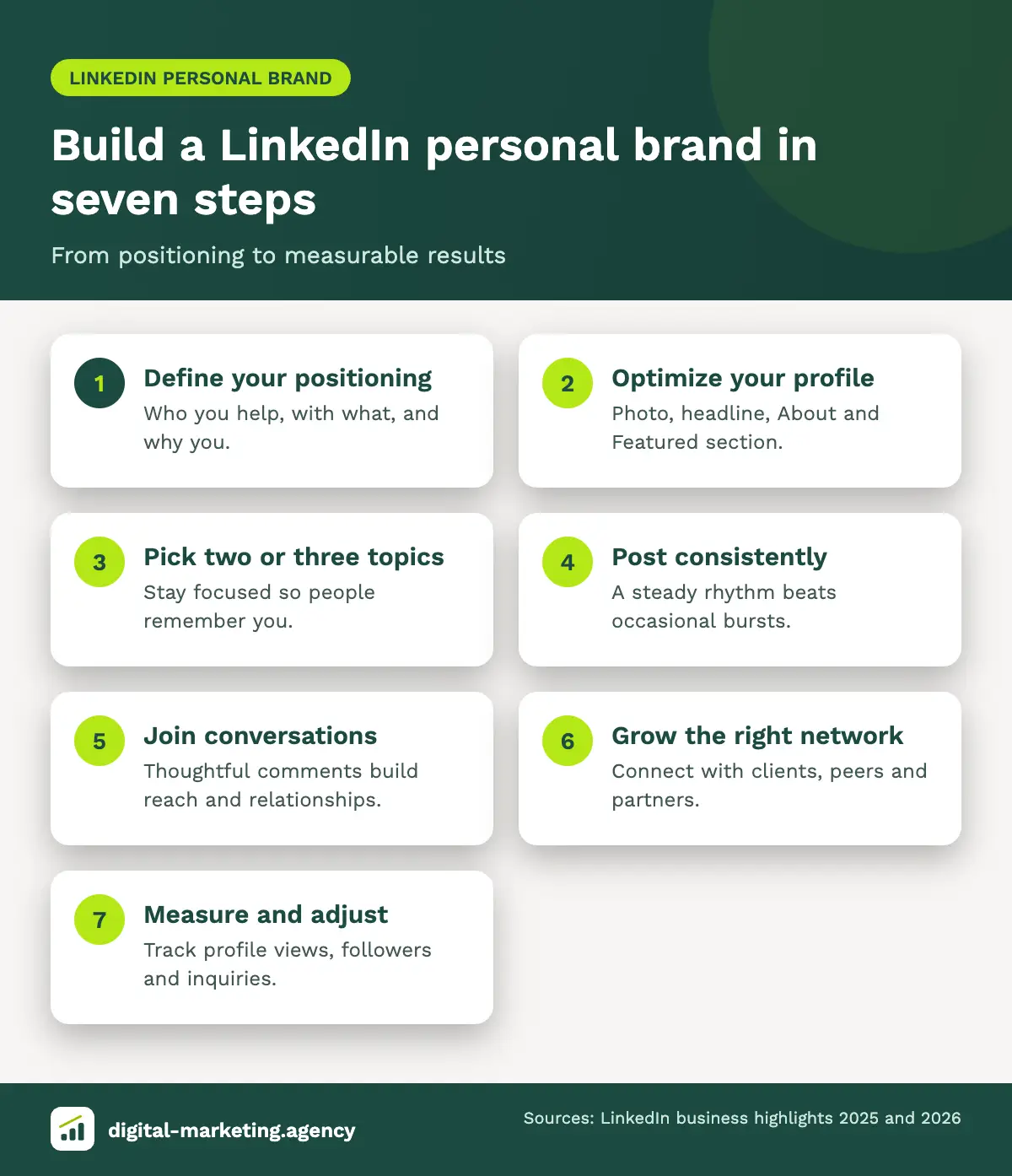
Step 1: Define your positioning
Every strong personal brand starts with a clear answer to three questions. Who do you help? With what? And why should people listen to you? Write your answer in one sentence. For example: “I help mid-sized manufacturers cut energy costs with practical efficiency projects.”
This sentence becomes the filter for everything else. Your headline, your topics and your posts should all support it.
Step 2: Optimize your profile
Your profile is the landing page of your LinkedIn personal brand. When a post gets attention, people click on your name. If the profile is unclear, they leave again. So check these elements first:
- a recent, friendly profile photo,
- a banner that shows your topic or offer,
- a headline that says who you help and how,
- an About section with your story and a clear next step,
- a Featured section with your best posts, case studies or articles.
We cover each element in detail in our guide to LinkedIn profile optimization. One note: the old Creator Mode no longer exists. LinkedIn retired it in 2024 and made its tools, such as the Follow button and newsletters, available to all members.
Step 3: Choose two or three core topics
People remember profiles that stand for something. Therefore, choose two or three topics where you have real experience and something to say. Stick to them for at least a few months. Variety is fine within these topics, but jumping between unrelated subjects weakens your LinkedIn personal brand.
LinkedIn personal branding
Build Your Brand With Expert Support
From profile optimization to a steady content plan and ghostwriting, we help you become visible on LinkedIn.
Step 4: Post consistently
Consistency builds recognition. One or two good posts per week are enough for most professionals, as long as you keep the rhythm over months. In addition, mix formats. Text posts work well for opinions and lessons, document posts for step-by-step guides and short videos for personality.
Quality matters more than tricks. In March 2026, LinkedIn rebuilt its feed with AI models that rank posts by meaning and relevance rather than by keywords. Useful, specific content therefore has a better chance than generic posts.
Step 5: Join conversations
Comments are an underrated part of any LinkedIn personal brand. A thoughtful comment under a relevant post can reach more people than your own post. It also builds relationships with peers, clients and journalists. Aim for comments that add a fact, an example or a different view, not just “Great post!”. If you also want to reach journalists with company news, our article on press releases in digital marketing explains how.
Step 6: Grow the right network
Followers are only valuable if they are the right ones. Connect with clients, prospects, partners and people in your industry. Add a short, personal note when you send a request. In addition, accept requests that fit your target group and politely ignore the rest.
Step 7: Measure and adjust
Track a few simple numbers every month: profile views, follower growth, post impressions, comments and, most importantly, inquiries. Which topics bring conversations? Which formats lead to profile visits? Use the answers to adjust your plan.
Common mistakes to avoid
- Posting about too many unrelated topics.
- Selling in every post instead of sharing knowledge.
- Copying viral formats that do not fit your personality.
- Giving up after a few weeks without results.
- Ignoring comments on your own posts.
How long does it take?
Building a LinkedIn personal brand is a long-term project. Most professionals notice more profile views and conversations within a few months of steady activity. A recognizable reputation in a niche usually takes longer. The good news: everything you build stays with you, even if you change jobs.
Conclusion
A strong LinkedIn personal brand rests on clear positioning, a complete profile, a few focused topics and steady, useful content. Add real conversations and regular reviews, and your visibility will grow step by step. As a digital marketing agency, we support founders and experts with strategy, profile optimization and content.
Learn more about our LinkedIn personal branding and ghostwriting packages, or book a free consultation.
FAQ
LinkedIn Personal Brand FAQs
Short answers to common questions about personal branding on LinkedIn.
What is a LinkedIn personal brand?
It is the reputation people connect with your name on LinkedIn. It comes from your profile, your posts, your comments and the way you interact with others. A good personal brand makes clear what you stand for and who you help.
How often should I post on LinkedIn?
One to three posts per week work well for most professionals. Consistency matters more than volume. It is better to post once a week for a year than every day for a month.
Does Creator Mode still exist?
No. LinkedIn retired Creator Mode in 2024. Its tools, such as the Follow button, newsletters and analytics, are now available to all members without a special setting.
What should I post about?
Post about two or three topics where you have real experience. Share lessons, opinions, examples from projects and answers to questions your clients ask often.
Should I post as a person or as a company?
Both, ideally. Personal profiles usually feel more human and get more interaction. Company pages are important for brand presence and ads. Many companies use employees’ profiles to bring the company’s expertise to life.
How do I measure the success of my personal brand?
Track profile views, follower growth, impressions and comments. The most important measure, however, is business impact: inquiries, invitations, job offers or new partnerships.
Can someone else write my LinkedIn posts?
Yes, many executives work with ghostwriters. The ideas, opinions and examples should still come from you. A good ghostwriter turns them into posts that sound like you.
How long does it take to build a personal brand?
Most people see first results, such as more profile views and conversations, within a few months of steady activity. A strong reputation in a niche usually takes a year or more.
It is the reputation people connect with your name on LinkedIn. It comes from your profile, your posts, your comments and the way you interact with others. A good personal brand makes clear what you stand for and who you help.
One to three posts per week work well for most professionals. Consistency matters more than volume. It is better to post once a week for a year than every day for a month.
No. LinkedIn retired Creator Mode in 2024. Its tools, such as the Follow button, newsletters and analytics, are now available to all members without a special setting.
Post about two or three topics where you have real experience. Share lessons, opinions, examples from projects and answers to questions your clients ask often.
Both, ideally. Personal profiles usually feel more human and get more interaction. Company pages are important for brand presence and ads. Many companies use employees’ profiles to bring the company’s expertise to life.
Track profile views, follower growth, impressions and comments. The most important measure, however, is business impact: inquiries, invitations, job offers or new partnerships.
Yes, many executives work with ghostwriters. The ideas, opinions and examples should still come from you. A good ghostwriter turns them into posts that sound like you.
Most people see first results, such as more profile views and conversations, within a few months of steady activity. A strong reputation in a niche usually takes a year or more.


