
Press releases in digital marketing are often called old-fashioned. Yet journalists still use them every day, and AI assistants now draw on the news they create. So the real question is not whether press releases still work. It is how to use them so they bring coverage, trust and visibility.
This article shows what a press release can do for your brand in 2026, where its limits are and how it fits into a modern marketing mix.
What press releases in digital marketing do today
A press release is an official announcement from a company. It goes to journalists, news portals and industry media. In the past, it was mainly a tool for print newspapers. Today, it also reaches online news sites, aggregators, social media and AI search tools.
In practice, a release can do four things for you:
- Earn media coverage: journalists pick up your news and write their own story.
- Create brand mentions: your company name appears on trusted news websites.
- Support search visibility: people search for your brand after they see the news.
- Feed AI answers: AI assistants use news content when they answer questions about your industry.
Journalists still rely on press releases
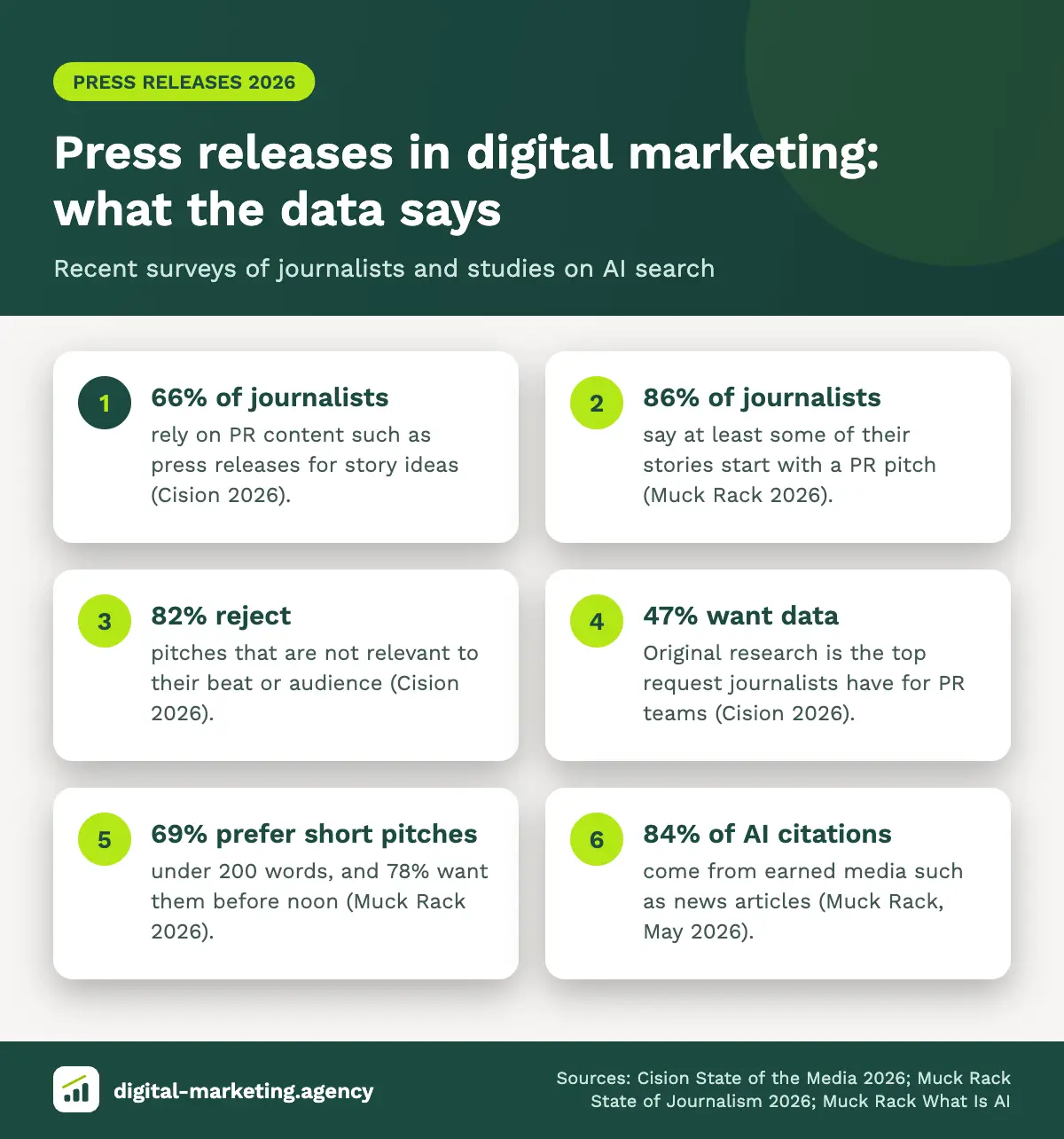
Many marketers assume that newsrooms ignore press releases. The data says otherwise. In the Cision 2026 State of the Media report, 66% of almost 1,900 journalists said they rely on PR content such as press releases, pitches and media kits for story ideas. In the 2025 edition, 72% even named press releases the most useful resource PR teams provide.
Muck Rack’s State of Journalism 2026 points in the same direction. There, 86% of journalists said that at least some of their stories start with a pitch from a PR team.
But relevance decides everything
At the same time, journalists are tired of weak pitches. According to Cision, 72% say fewer than a quarter of the pitches they get are relevant. In addition, 82% name a lack of relevance as a reason to reject a pitch, and 53% reject pitches that sound too promotional. A press release therefore only works if it carries real news for the right audience.
How press releases support SEO and brand trust
Press releases help your visibility in Google, but not in the way many people think. They are not a shortcut to backlinks. Google’s spam policies list links with optimized anchor text in press releases distributed on other sites as link spam. For this reason, links in wire releases should carry rel="nofollow" or rel="sponsored".
The real SEO value comes from what happens after the release. For example, a journalist may write an article and link to your website on their own. Your brand gets mentioned on news portals. More people search for your company name. Each of these effects strengthens the trust signals around your brand. We explain this in detail in our article on how press releases support SEO and brand authority.
Get Your News in Front of Journalists
We write your press release and distribute it to more than 450 news sites, with a clear news angle and full reporting.
Press releases and AI search
AI assistants such as ChatGPT, Claude and Gemini build their answers from sources they consider reliable. Muck Rack analyzed more than 25 million links cited by these tools. In its May 2026 report, earned media made up 84% of all citations. Paid content, by contrast, accounted for just 0.3%.
Press releases themselves are not a major source of AI citations. However, they are often the starting point for the news articles that AI tools do cite. Muck Rack also found that the releases that did get cited contained about twice as many statistics and 2.5 times as many bullet points as average. In other words, clear facts and a clean structure make your news easier to reuse.
When a press release makes sense
Not every update deserves a press release. A simple rule helps: if a journalist outside your company would care, it is news. Typical occasions are:
- a new product, service or market launch,
- original research, survey results or industry data,
- awards, certifications and partnerships,
- new managers or key hires,
- events, expansions and company milestones.
Small updates, such as a new blog post or a minor website change, are better suited to your newsletter or social media.
How to get more out of each press release
Lead with a clear news angle
Start with the most important fact. The first two sentences should answer who, what, when, where and why. Even if an editor reads only the first paragraph, they should still understand the story.
Add data, quotes and visuals
Journalists ask for substance. In the Cision 2026 report, 47% wanted more data or research from PR teams, and 32% wanted more multimedia. So add one strong quote from a named person, a few hard facts and an image in high resolution.
Keep the pitch short and send it early
Shorter is better. In Muck Rack’s survey, 69% of journalists preferred pitches under 200 words, and 78% wanted to receive them before noon. The release itself can be longer, but the email that introduces it should be brief.
Reuse the news on your own channels
Publish the release on your website, share it on LinkedIn and mention it in your newsletter. That way, the news reaches customers directly, even if no journalist picks it up. Sharing it from the profiles of your founders or experts can extend its reach, especially if they have built a LinkedIn personal brand. Our guide on press releases and SEO shows how to connect the release with your website.
Common myths about press releases
- “Press releases are a link building tactic.” Not true. Google treats optimized links in distributed releases as link spam and tries to ignore them. We cover similar traps in our overview of link building mistakes that hurt SEO.
- “Journalists no longer read them.” Survey data from Cision and Muck Rack shows the opposite.
- “Distribution alone is enough.” Distribution makes your news visible. Coverage, however, depends on news value and the right contacts.
Conclusion
Press releases in digital marketing are far from dead. They remain a trusted source for journalists, they create brand mentions on news sites and they feed the content that AI assistants rely on. What matters is real news, clear facts and honest expectations about links. As a digital marketing agency, we see the best results when a release is part of a wider plan with content, social media and SEO.
Do you have news to share? Our press release services cover writing, distribution and reporting.
Press Release FAQs
Short answers to common questions about press releases, SEO and media coverage.
Are press releases still effective in 2026?
Yes, if the news is relevant. Recent surveys show that most journalists still use PR content for story ideas. Releases without a clear news angle, on the other hand, are ignored. Quality and timing matter more than volume.
Do press releases help SEO?
Indirectly, yes. The links inside a distributed release carry little ranking value. However, coverage, editorial links from journalists, brand mentions and more branded searches all support your visibility over time.
Should links in press releases be nofollow?
Yes. Google treats links with optimized anchor text in distributed press releases as link spam. Mark such links as nofollow or sponsored. A plain link to your homepage in the company description is common and safe.
How long should a press release be?
One page is usually enough. Put the key facts in the first paragraph and keep the rest short. The email you send to journalists should be even shorter. Most of them prefer pitches under 200 words.
How often should a company send press releases?
Send a release whenever you have real news, not on a fixed schedule. For many companies, that means a few times per year. Sending too often with weak news can hurt your reputation with editors.
Can press releases improve visibility in AI search?
Yes, mostly through the coverage they create. AI assistants cite earned media far more often than paid content. Releases with clear facts, figures and bullet points are easier for AI tools and journalists to reuse.
What is the difference between a press release and a media pitch?
A press release is a formal announcement that anyone can read and publish. A media pitch is a short, personal email to one journalist. It explains why the story fits their beat. Both work best together.
Do I need a distribution service?
A distribution service gets your release onto many news portals at once. That builds visibility and brand mentions. Personal outreach to relevant journalists is still needed if you want them to write their own articles.


[…] Regular, credible news therefore helps your brand appear in these answers as well. Our article on why press releases still matter looks at the latest data on journalists and AI […]
[…] data, partners you work with, associations you are a member of. Digital PR, for example a survey or a strong news story, can earn links from media that you would never reach through cold outreach. Our article on press […]
[…] not just “Great post!”. If you also want to reach journalists with company news, our article on press releases in digital marketing explains […]
Comments are closed.