
Press releases are often seen as an old-fashioned PR tool. In reality, press releases and SEO work well together and can do a lot for your online visibility, as long as you understand what they achieve and what they do not. A well-written release about real news can generate media coverage, brand mentions on trusted websites, editorial links and more branded searches. A release used only to collect backlinks, on the other hand, achieves little and can even be risky.
This article explains how press releases support SEO and brand authority, where the limits are and how to get the most out of your next announcement.
How press releases contribute to search visibility
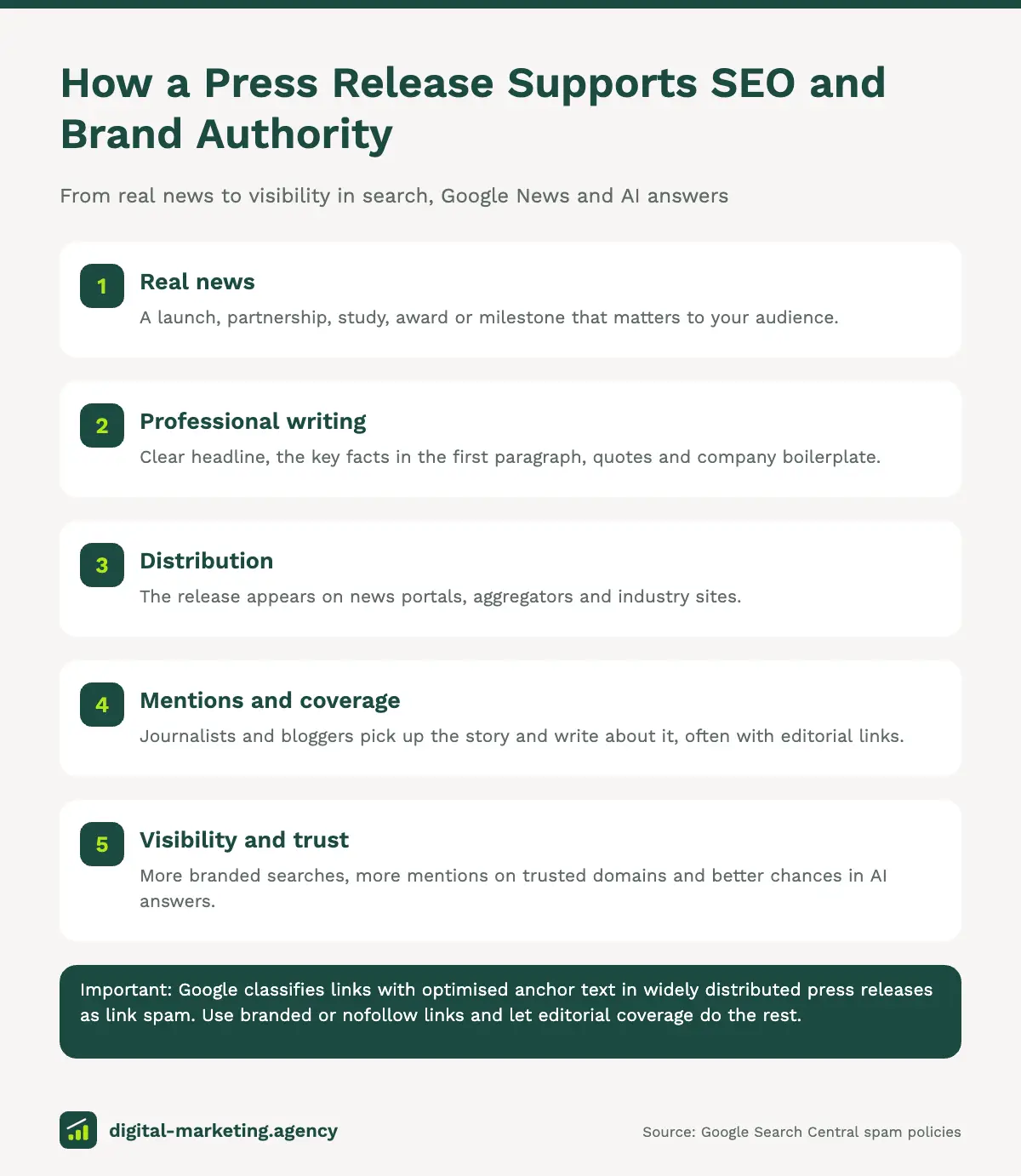
A press release is an official announcement that is distributed to news portals, aggregators, industry websites and journalists. When it is published, your news appears on many websites at once, often within a few hours. Several effects come together here.
Brand mentions on trusted websites
Each publication mentions your company, your products and your key people in a news context. Search engines and AI systems use such mentions to understand who you are and what you stand for. The more consistently your brand appears on trusted websites, the clearer this picture becomes.
Editorial coverage and natural links
The most valuable effect comes after distribution. If journalists or bloggers find your story interesting, they write their own articles about it and often link to your website. These editorial links are exactly the kind of links that search engines value.
More branded searches
People who read about your company in the news often search for your brand name afterwards. More branded searches and visits are a sign of a growing brand and support your overall visibility.
Visibility in Google News and AI answers
Releases published on news portals can appear in Google News and in search results for current topics. AI assistants such as ChatGPT or Perplexity also draw on news sources when answering questions about companies and industries. Regular, credible news therefore helps your brand appear in these answers as well. Our article on why press releases still matter looks at the latest data on journalists and AI search.
What press releases cannot do
Press releases are not a shortcut to backlinks. Many links in syndicated releases are marked nofollow, and Google’s spam policies explicitly name links with optimized anchor text in widely distributed press releases as an example of link spam. Use your brand name or a plain URL as a link and let editorial coverage do the rest.
For Successful Press Releases
We write your press release and distribute it to more than 200 media outlets and 450+ news sites, with a report on every publication.
How to write a press release that works
Start with real news
Journalists are only interested in news that matters to their readers: a product launch, a partnership, a study, an award, an expansion or a new appointment. If the news is weak, even the best distribution will not help.
Put the key facts first
A good release follows the classic news structure: a clear headline, a first paragraph that answers who, what, when, where and why, and a body with details, figures and a quote. It ends with a short company profile (boilerplate) and contact details. Write factually, not like an advertisement.
Add a quote and visuals
A quote from your management gives the story a human voice and can be used directly by journalists. Images, charts or a short video make the release more attractive and increase the chances that it is picked up.
Use keywords naturally
Use the terms your audience searches for in the headline and the first paragraph, but write for people. Keyword stuffing makes the release less readable and does nothing for your rankings.
Getting more out of every release
Publish the release in a newsroom on your own website, share it on LinkedIn and other channels and send it personally to journalists who cover your topic. A press release works best as part of a wider strategy that includes digital PR, thought leadership content and active link building strategies. Regular announcements, for example every one to three months, keep your brand visible.
Common mistakes with press releases
- Announcing something that is not really news.
- Stuffing the release with keyword links to your website.
- Writing in advertising language instead of a factual tone.
- Choosing distribution channels that do not reach your audience.
- Publishing once and never following up with journalists.
Some of these mistakes are similar to the common link building mistakes we describe in another article.
Conclusion
Press releases support SEO and brand authority in an indirect but valuable way: through brand mentions on trusted websites, editorial coverage with natural links, more branded searches and visibility in Google News and AI answers. They are not a tool for collecting backlinks. If you announce real news, write professionally and distribute your release to the right channels, it becomes a lasting building block of your online visibility.
If you are looking for quality coverage, explore our press release packages.
Press Releases and SEO FAQs
Short answers to common questions about press releases, SEO and brand authority.
Do press releases help SEO?
Yes, but mainly indirectly. Press releases create brand mentions on trusted websites, can lead to editorial coverage with natural links and increase branded searches. The links in the release itself usually have little direct effect on rankings.
Are links in press releases dofollow?
Often not. Many news portals and distribution services mark links in press releases as nofollow. Google’s spam policies also name links with optimized anchor text in widely distributed press releases as link spam, so use your brand name or a plain URL.
Can press releases hurt my SEO?
They can, if they are used purely for link building with keyword anchors or distributed through low-quality networks. Releases about real news with natural links are safe and useful.
What makes a press release newsworthy?
Real relevance for the audience: a launch, partnership, study, award, expansion or appointment. Original data, a strong quote and good visuals increase the chances that journalists pick up the story.
How often should a company publish press releases?
Whenever there is real news. For many companies, one release every one to three months is realistic. Regular announcements keep your brand visible, but quality is more important than frequency.
Do press releases help with visibility in AI search?
Indirectly, yes. AI assistants draw on news sources and trusted websites when they answer questions about companies and industries. Regular, credible coverage makes it more likely that your brand is mentioned.
How long should a press release be?
Most press releases are between 300 and 800 words. What matters is that the key facts are in the headline and the first paragraph and that the text contains no unnecessary filler.
How do I measure the success of a press release?
Look at the number and quality of publications, editorial articles that picked up the story, referral traffic, branded searches in Google Search Console and enquiries in the weeks after publication. A distribution report shows where the release appeared.


[…] Coverage in respected media brings links that are difficult to get any other way. Our article on press releases and SEO shows how news can support your […]
[…] story, can earn links from media that you would never reach through cold outreach. Our article on press releases and SEO explains how news can support your […]
[…] The real SEO value comes from what happens after the release. For example, a journalist may write an article and link to your website on their own. Your brand gets mentioned on news portals. More people search for your company name. Each of these effects strengthens the trust signals around your brand. We explain this in detail in our article on how press releases support SEO and brand authority. […]
Comments are closed.