
Most link building advice is written for bloggers and SEO specializts. Businesses are in a different position: they have customers, partners, suppliers, data and expert knowledge, but often no time for endless outreach. The good news is that these assets are an excellent basis for earning links that are relevant, trusted and hard for competitors to copy. Below, you will find eight proven link building strategies for businesses: practical tactics that build on exactly these assets.
This article presents eight link building strategies that work particularly well for companies, from turning your expertise into content to reclaiming brand mentions you have already earned.
Why link building matters for businesses
Successful link building strategies for businesses start with one insight: links are earned through relationships and real value. Links help Google discover your pages and judge how trustworthy they are. According to Backlinko, the page in position one on Google has on average 3.8 times more backlinks than the pages in positions two to ten. At the same time, Ahrefs found that 96.55% of pages get no traffic from Google, and a lack of backlinks is one of the main reasons. For businesses, this means: without links, even excellent service pages and articles often remain invisible. Our article on why backlinks matter explains the background in detail.
Link building is also demanding. Good links take time, and many companies give up too early. Those who stick with a few suitable strategies gain a lasting advantage over competitors who neglect this work.
8 link building strategies for businesses
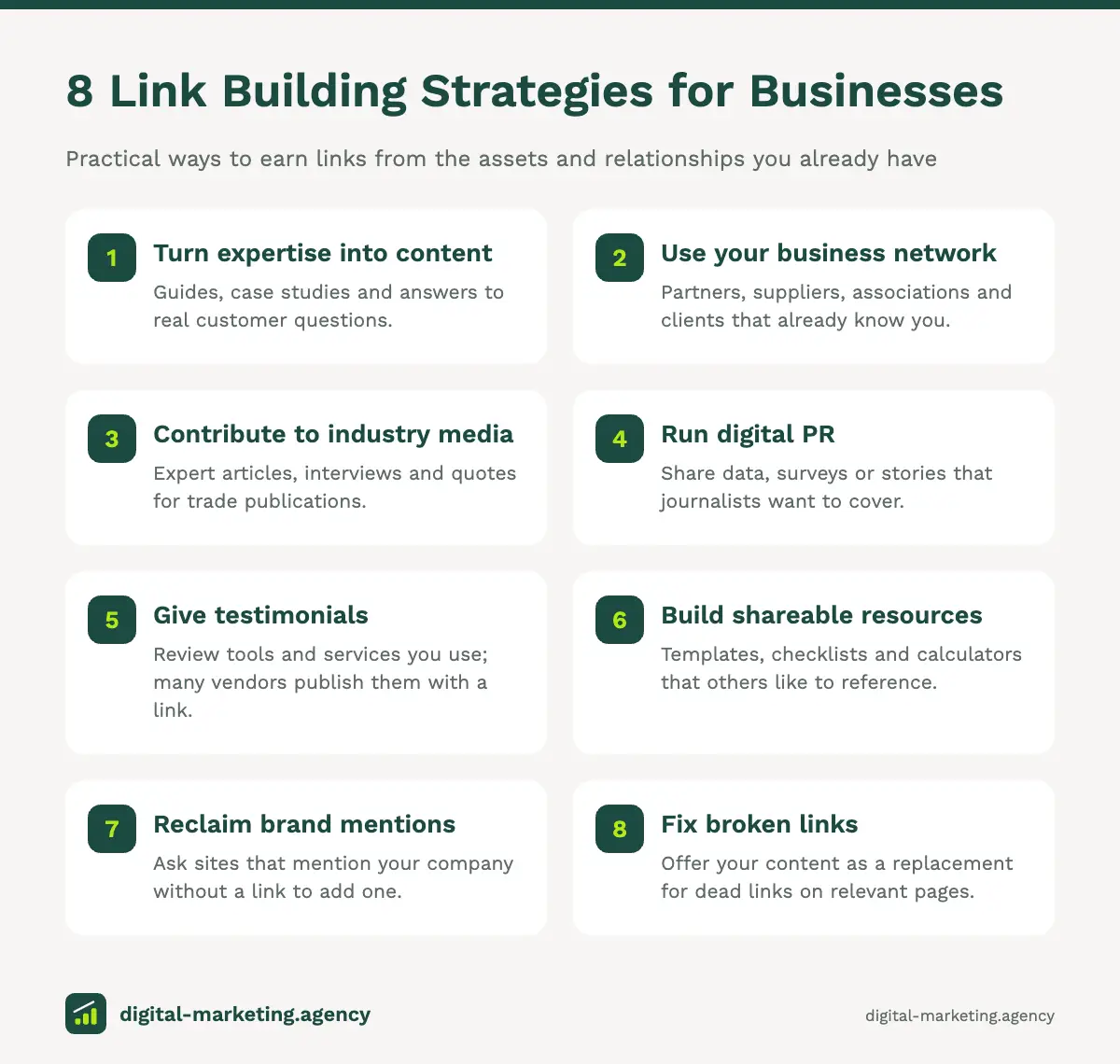
1. Turn your expertise into linkable content
Every company knows things that others want to know: how a process works, what something really costs, which mistakes to avoid. Guides, case studies and honest answers to typical customer questions attract links because they help other authors support their points. Original data from your own business, such as an annual benchmark or a customer survey, is especially effective.
2. Use your business network
Partners, suppliers, distributors, clients and associations already know your company. Many of them have partner pages, reference lists or member directories where a link to you makes sense. These links are relevant and based on real relationships, which is exactly what search engines value. Be careful with pure link exchanges, though: Google’s spam policies warn against excessive “link to me and I’ll link to you” arrangements.
3. Contribute to industry media
Trade magazines, industry blogs and podcasts are always looking for expert contributions. A well-written article, an interview or a quote from your management builds authority and often brings a link. Choose publications your buyers read, and write content that stands on its own without hidden advertising.
4. Run digital PR
Digital PR means giving journalists a reason to write about you: a study, a survey, a strong opinion on a current topic or genuine company news. Coverage in respected media brings links that are difficult to get any other way. Our article on press releases and SEO shows how news can support your visibility.
For Measurable Backlink Growth
We turn your expertise, data and partnerships into relevant links through manual outreach.
5. Give testimonials
Companies regularly use software, tools and services from other providers. Many of these providers publish customer testimonials with a link to the customer’s website. A short, honest testimonial for a product you actually use is a simple way to earn a relevant link and strengthen a business relationship at the same time.
6. Create shareable resources
Templates, checklists, calculators and small tools solve practical problems. When a resource saves people time, they share it and link to it. A marketing agency might offer a content calendar template, an accounting firm a tax deadline calendar, a manufacturer a technical selection guide.
7. Reclaim unlinked brand mentions
Your company is probably mentioned online more often than you think, in articles, event reports or industry lists, but not always with a link. Set up alerts for your company name and products, and politely ask the authors to add a link. Because they already know you, the success rate is usually high.
8. Fix broken links on relevant pages
Websites in your industry often contain links to pages that no longer exist. If you have content that covers the same topic, you can point this out to the site owner and suggest your page as a replacement. You help them fix an error and earn a relevant link in return.
How to choose link building strategies for businesses
No company needs all eight strategies at once. Start with the ones that suit your resources: strong expertise favors content and media contributions, a large network favors partner links and testimonials, real news favors digital PR. Measure which strategies bring links and visitors, and invest more in those. Our guide on building high-quality backlinks describes the process step by step, and our checklist of what makes a backlink valuable helps you assess opportunities.
Stay consistent and avoid risky shortcuts
Links need time to work, usually several months. A steady flow of good links looks natural and builds lasting authority. Buying links for ranking purposes, link farms or automated tools may look like shortcuts, but they can lead Google to ignore your links or take manual action. More on this in our article on link building mistakes.
Conclusion
Businesses have excellent starting conditions for link building: expertise, relationships, data and news. If you use these assets systematically, you earn links that are relevant, trusted and difficult for competitors to copy. Choose two or three strategies that fit your company, stay consistent and measure the results.
If you need help implementing these tactics, book a free consultation.
Link Building FAQs
Short answers to common questions about link building for businesses.
Which link building strategy works best for small businesses?
For many small businesses, the quickest wins come from their existing network: partners, suppliers, local associations and testimonials. After that, useful content based on their own expertise is the most sustainable strategy.
Are links from partners and suppliers useful?
Yes, as long as the link makes sense for the visitor, for example on a partner page or in a reference list. Pure link swaps without any real relationship are a different matter and can be classed as link schemes.
How do I find unlinked mentions of my brand?
Set up alerts for your company name, products and key people, for example with Google Alerts or an SEO tool. Check each mention and, if there is no link, write a short, friendly message to the author.
Is digital PR worth it for B2B companies?
Yes. Trade media, industry portals and business journalists are always looking for data, expert opinions and news. Coverage in these media builds trust with buyers and brings high-quality links at the same time.
Can I exchange links with other businesses?
Occasional mutual links between businesses that really work together are normal. Google’s spam policies warn against excessive link exchanges whose main purpose is to manipulate rankings.
How long does link building take to show results?
Google usually discovers new links within a few weeks. A visible effect on rankings typically takes three to six months. Link building pays off most when it is done continuously over a longer period.
Should I do link building in-house or hire an agency?
That depends on your resources. Companies with strong expertise and time can do a lot in-house, for example content and media contributions. An agency brings experience, publisher contacts and tools and saves time on research and outreach. Many companies combine both.
How do I measure the success of link building?
Track the number of new referring domains, the quality of the linking websites, the rankings of the pages you promote, referral traffic and, ideally, enquiries from organic search. Google Search Console and an SEO tool are enough to get started.


[…] best as part of a wider strategy that includes digital PR, thought leadership content and active link building. Regular announcements, for example every one to three months, keep your brand […]
[…] trade media, blogs, partners, associations, news sites and resource pages. Our overview of link building strategies for businesses shows where these links can come […]
Comments are closed.