
Many companies publish good content and are still hard to find on Google. Very often the reason is not the content itself, but the fact that hardly any other website points to it. Backlinks remain one of the clearest signals search engines use to decide which pages deserve attention. In 2026 they also influence which brands appear when people ask AI assistants for recommendations.
This article explains what backlinks are, how they affect rankings and visibility, which links really help and where the risks lie. That way you can judge how much effort link building deserves in your own marketing.
What are backlinks?
A backlink is a link from another website to yours. If an industry magazine writes about your company and links to your service page, that magazine has given you a backlink. Search engines use such links in two ways: as a path to discover your pages and as a kind of recommendation.
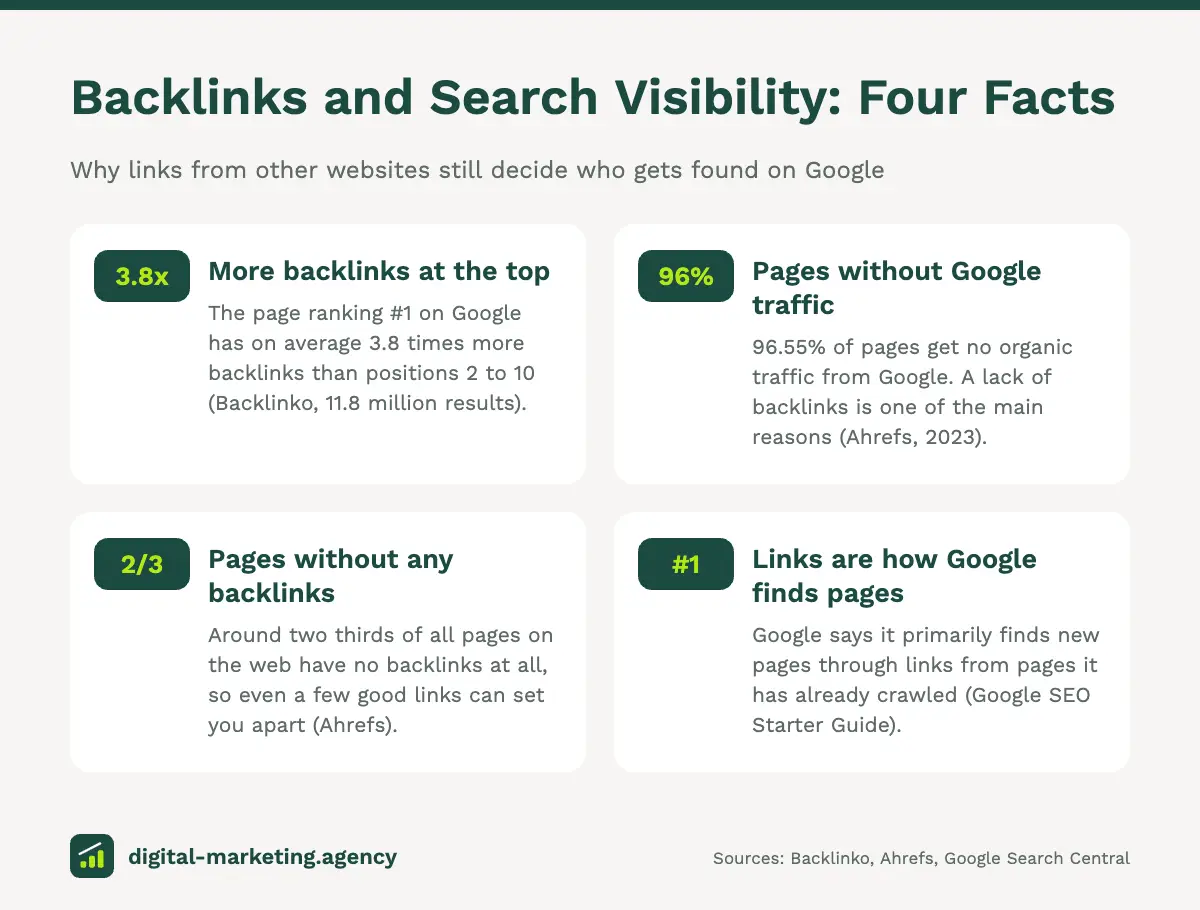
Google describes links as its main way of finding content. In its SEO Starter Guide, Google explains that it primarily finds pages through links from pages it has already crawled. A page that nobody links to is harder to discover and has fewer signals that it is worth showing.
How backlinks influence rankings
Google has never published an exact formula, but large studies keep showing the same pattern. Backlinko’s analysis of 11.8 million Google results found that the page in position one has on average 3.8 times more backlinks than the pages in positions two to ten.
Correlation is not proof, and links are only one factor among many. Helpful content, search intent and technical quality matter just as much. Still, in competitive markets it is rare to see a page reach the top positions without a solid link profile behind it.
Links help Google find and understand your pages
Every link is a route for search engine crawlers. The more relevant pages link to you, the faster new content is discovered and the more often it is revisited. The words used in the link, the so-called anchor text, also tell Google what the linked page is about.
Links pass on trust and authority
A link from a respected website works like a reference. If a well-known trade publication links to your study, it vouches for your content to some extent. Links from strong, relevant websites carry far more weight than many links from small or unrelated sites.
Links bring visitors directly
Backlinks are not only a ranking signal. A link in a popular article sends readers straight to your website. This referral traffic is often highly qualified, because the visitors arrive with context and a specific interest.
Links support visibility in AI search
AI assistants such as ChatGPT, Perplexity or Google’s AI Overviews build their answers from sources they consider reliable. Brands that are mentioned and linked on many trusted websites tend to appear more often in these answers. Backlinks and brand mentions therefore help with both classic SEO and generative search.
Want to know how strong your current link profile is? Book a free consultation and we will take a look together.
For Measurable Backlink Growth
We build relevant backlinks through manual outreach and editorial placements, with transparent reporting on every link.
Why most pages get no search traffic
The gap between pages with and without links is enormous. In its 2023 study, Ahrefs found that 96.55% of all pages get no organic traffic from Google at all. A lack of backlinks is one of the main reasons, alongside topics nobody searches for and content that misses the search intent.
The same data shows how rare success without links is: of around 20 million pages without a single referring domain, only 2,997 received more than 1,000 search visits per month. In an earlier analysis, Ahrefs also found that around two thirds of all pages have no backlinks. For you, this means that even a handful of good links can set your content apart.
Which backlinks actually help
Not every link is worth having. The links that move rankings usually share a few characteristics:
- Relevance: the linking website covers your topic or industry.
- Authority: the site is established and has strong links of its own.
- Editorial context: the link sits inside the main text and adds value for the reader.
- Natural anchor text: the wording fits the sentence instead of repeating a keyword.
- Diversity: links come from many different domains, not from the same few.
We explain these points in detail in our article on what makes a backlink valuable.
Backlinks that can hurt you
Because links are so influential, there are many shortcuts, and most of them are risky. Google’s spam policies name several practices as link spam, including:
- buying or selling links for ranking purposes,
- excessive link exchanges (“link to me and I’ll link to you”),
- links with optimized anchor text in widely distributed guest posts or press releases,
- automated programs or services that create links to your site.
Paid or sponsored links are not forbidden as such, but Google expects them to be marked with rel="sponsored" or rel="nofollow". Links that break these rules can be ignored by Google or, in serious cases, lead to a manual action. You will find the most common pitfalls in our article on link building mistakes.
How to start building backlinks
Good link building starts with content that deserves links: original data, practical guides, tools or a clear expert opinion. From there, you can approach relevant websites, contribute to industry media, use your business network and run digital PR. Our guide on how to build high-quality backlinks walks through the process step by step, and our overview of link building strategies for businesses shows which approaches suit companies best.
Conclusion
Backlinks remain a core part of SEO in 2026. They help Google find your pages, signal trust, bring in qualified visitors and support your visibility in AI search. What counts is quality: a few relevant links from respected websites achieve more than hundreds of weak ones, and shortcuts like bought or automated links carry real risk.
If you would like support, our link building services combine manual outreach with transparent reporting.
Backlink FAQs
Short answers to common questions about backlinks, rankings and visibility.
Do backlinks still matter for SEO in 2026?
Yes. Links remain one of the most important signals Google uses to find pages and judge their trustworthiness. Large studies show that top-ranking pages usually have considerably more backlinks than the pages below them. Content quality and search intent matter just as much, but strong content without links rarely reaches the top positions in competitive markets.
How many backlinks do I need to rank on page one?
There is no fixed number. It depends on how competitive the search term is and how strong the pages already ranking are. A useful approach is to look at the referring domains of the top five results for your keyword. That tells you roughly what level of authority you need to compete.
What is the difference between dofollow and nofollow links?
A normal (“dofollow”) link can pass ranking signals to the linked page. A link marked with rel="nofollow", rel="sponsored" or rel="ugc" tells Google not to treat it as an endorsement. Nofollow links can still bring visitors and brand awareness, and a natural profile usually contains both types.
Can backlinks hurt my website?
Yes. Bought links, link farms, automated link building and spammy directories can lead Google to ignore your links or, in serious cases, to a manual action. If you find many harmful links pointing to your site, you can ask the site owners to remove them or, as a last resort, use Google’s disavow tool.
How long does it take for backlinks to affect rankings?
Google usually discovers new links within a few weeks. A noticeable effect on rankings typically takes three to six months, depending on the strength of the links, the competition and how often Google crawls the pages involved. Referral traffic can start much sooner.
Are backlinks important for local businesses?
Yes. For local businesses, links from local newspapers, chambers of commerce, associations, suppliers and regional directories are particularly valuable. They strengthen both regular rankings and visibility in local search results.
Do backlinks help with visibility in AI search tools?
Indirectly, yes. AI assistants build their answers from sources they consider reliable. Brands that are mentioned and linked on many trusted websites have a better chance of appearing in these answers. Backlinks, press coverage and brand mentions therefore work together.
Should I buy backlinks?
Google’s spam policies classify buying links for ranking purposes as link spam. Paid placements are allowed if they are marked with rel="sponsored" or rel="nofollow". The safest long-term approach is to earn links through useful content, outreach, digital PR and relationships in your industry.


[…] Having a presence on the internet for a business is no longer just about having a website. It is about making sure people can actually find that website. With so many different companies vying for business, online businesses need strong signals to succeed in the search results. One of the most reliable ways to do this is through effective link building strategies. […]
Comments are closed.